Several robots
One simulator can run several Kachakas in the same world. Each has its own
ROS 2 namespace, TF frames and kachaka-api port, and they all share one map
frame. fleet.launch.py starts Nav2 for each robot on a saved map. Each robot
sees the others in its LiDAR scan and keeps their footprints in its costmaps.
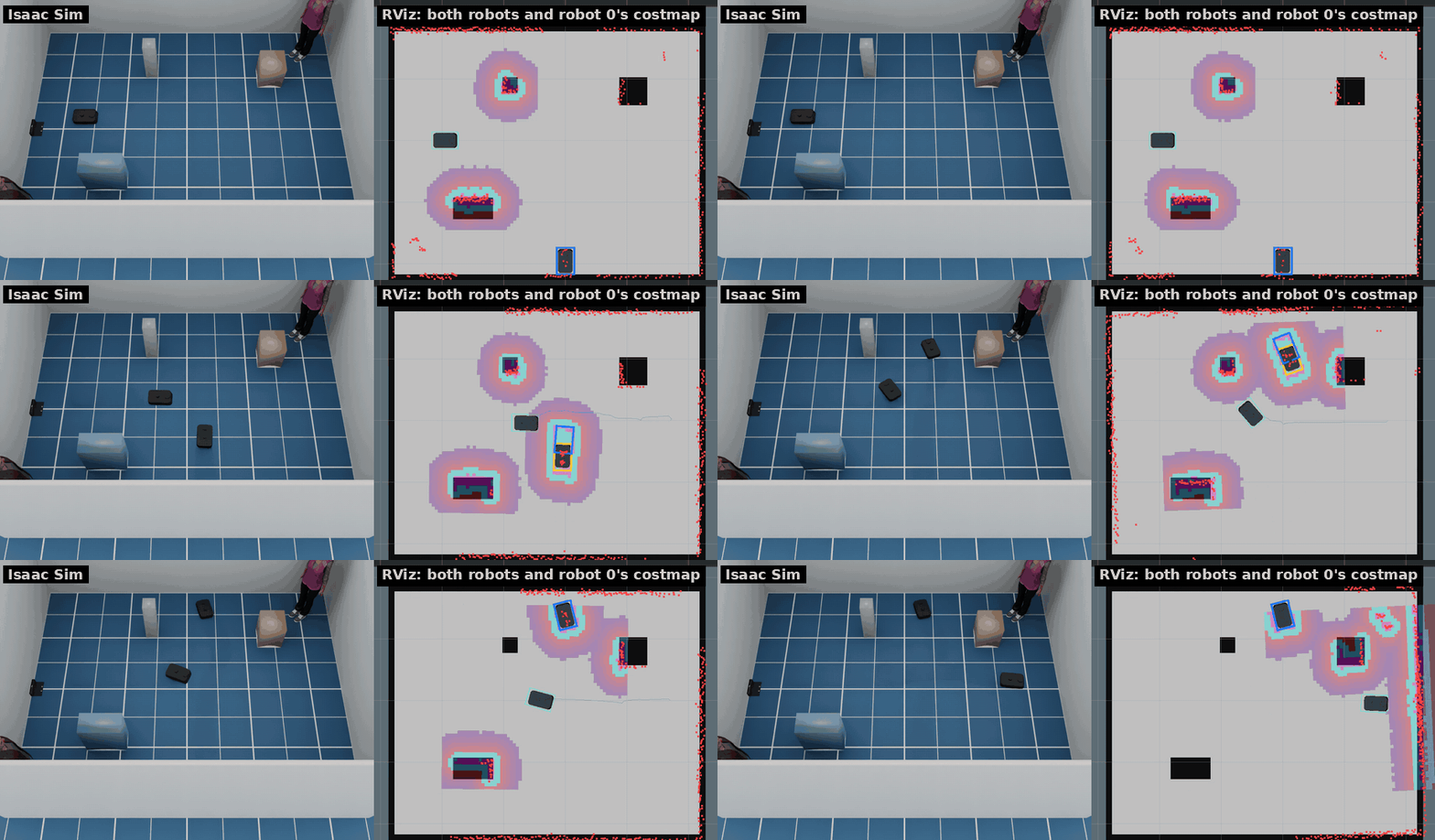
Two robots on one map, their paths crossing (scripts/record_demo.sh fleet).
Quick start
Two robots in the default room, navigating on a shared map. Run the
python3 and ros2 commands in the ROS 2 container
(docker compose -f docker/compose.yaml run --rm shell).
# 1. The room's map, with the map frame at robot 0's spawn pose (maps/room.yaml)
python3 scripts/make_maps.py --spawn -1.7 0.2 0

# 2. The simulator with two robots (on the host)
scripts/run_sim.sh --no-cameras --no-shelves --robot -1.7 0.2 0 --robot 0.3 -1.8 1.5708

# 3. Nav2 for both robots, with robot 1's start in the map frame
ros2 launch kachaka_sim_bringup fleet.launch.py map:=/maps/room.yaml robots:=2 initial_poses:=2.0,-2.0,1.5708

# 4. Send robot 1 a goal
ros2 action send_goal /kachaka_1/navigate_to_pose nav2_msgs/action/NavigateToPose \
    '{pose: {header: {frame_id: map}, pose: {position: {x: 2.0, y: 0.5}, orientation: {z: 0.7071, w: 0.7071}}}}'
The simulator prints a line for each extra robot before it is ready:
[kachaka] robot 1: ROS namespace '/kachaka_1', frames 'kachaka_1/...', start (2.000, -2.000, 1.571) in the map frame, kachaka-api on port 26401
[kachaka] running: ROS namespace '/kachaka', world 'room', charger at (-2.27, 0.0, 0.0), kachaka-api on port 26400
The start it prints is the value to pass to initial_poses.
Placing the robots
--robot X Y YAW adds one robot, in the world frame, and can be repeated. It
replaces --x, --y and --yaw. The first --robot is robot 0, the next
robot 1, and so on. Layouts with an elevator take one robot only.
Names
Robot 0 keeps the single-robot names, so code written for one robot works on
it unchanged. Robot i (1, 2, …) gets the suffix _i:
| Robot 0 | Robot i | |
|---|---|---|
| Prim | /World/kachaka |
/World/kachaka_i |
| Topics | /kachaka/... |
/kachaka_i/... |
| TF frames | odom, base_footprint, … |
kachaka_i/odom, kachaka_i/base_footprint, … |
Nav2 (with fleet.launch.py) |
/navigate_to_pose, /initialpose, … |
/kachaka_i/navigate_to_pose, /kachaka_i/initialpose, … |
| kachaka-api | --api-port (26400) |
--api-port + i (26401, …) |
| Noise seed | --seed |
--seed + 1000 i |
All robots share one /clock, one /tf and one map frame, whose origin is
robot 0's spawn pose.
Navigation
fleet.launch.py map:=<yaml> robots:=N starts navigation.launch.py for
robot 0 (with RViz and robot 0's command, charger and shelf servers) and
robot_nav.launch.py under /kachaka_i for each other robot. Each robot
gets its own AMCL, planner and controller, with nav2_params.yaml rewritten
for its frames and topics.
| Argument | Default | |
|---|---|---|
map |
the map YAML, shared by all robots | |
robots |
2 | how many robots the simulator runs |
initial_poses |
x,y,yaw of robots 1, 2, … in the map frame, in a row |
|
rviz |
true | RViz, with a model for each robot |
- Starting poses. Robot 0's AMCL starts at the map origin, its spawn
pose.
initial_posesgives the others' starts, so every robot is localized, and drawn in RViz, from the start. A robot without one waits for a pose on its own/kachaka_i/initialpose. - The map. Build it before starting the fleet:
make_maps.pyfor the room or a layout, or slam_toolbox with robot 0 alone. The map frame must be robot 0's spawn pose. There is no launch file for SLAM with several robots. - Goals. RViz's 2D Goal Pose sends goals to robot 0. Send the others
goals on their own
navigate_to_poseaction, as in the quick start, or from your own nodes. - Each other. The LiDAR sees only 9 cm of another robot's 24 cm body
(the laser housing sticks up above the body; the rest is lower than the
scan plane).
fleet_outlinestherefore puts every robot's Nav2 footprint, placed with its AMCL pose, into the others' costmaps and collision monitors on{namespace}/other_robots(yellow outline in RViz, blue 0.5 s ahead). The parts of a body at the LiDAR's height (the housing and a bump at the back, from a slice of the official body mesh) are intersected with the scan in 2D and have no collider, so a shelf's bottom plate (0.107 m) still clears the body. - No traffic rules. The Nav2 stacks do not negotiate with each other. Two robots that meet nose to nose in a narrow place can block each other until their goals abort. Taking turns is a fleet manager's job, outside the simulator.
kachaka-api per robot
Each robot serves kachaka-api on its own port. Robot 0's API is complete (see kachaka-api). The servers that run commands, shelves and locations belong to robot 0, so robot i's API covers less:
| On robot i's port | Works |
|---|---|
Pose and battery (get_robot_pose, get_battery_info) |
yes; the pose is in the shared map frame once fleet.launch.py runs, in robot i's odom frame before |
Manual driving (set_manual_control_enabled, set_robot_velocity) |
yes |
Commands (start_command, move_to_pose, rotate_in_place, …) |
no: error −6, server unavailable |
Locations and shelves (get_locations, get_shelves) |
no: the call does not return; avoid it |
from kachaka_api import KachakaApiClient

robot1 = KachakaApiClient("127.0.0.1:26401")
print(robot1.get_robot_pose())
What the other robots lack
- No cameras (front, back, ToF) and no object detection.
- No shelves: shelves and their docking belong to robot 0.
- No charger of their own: they share robot 0's.
sim/resetof robot i puts robot i back at its spawn pose. Robot 0's reset resets the world as well.
Doors, automatic doors and moving people react to every robot.
Tests
tests/ros_multi_check.py |
two robots facing each other: separate topics, TF and odometry, each drives on its own commands and sees the other |
tests/ros_multi_nav_check.py |
two robots on one map, paths crossing at right angles: both arrive without touching |
scripts/smoke_test.sh runs the first, and smoke_test.sh --nav runs both.
See the docstrings for the simulator command lines they expect.