How it works
The tool builds against Fast DDS 2.6 (ROS 2 Humble), 2.14 (Jazzy) and 3.x (Lyrical,
Rolling); the API differences live in include/fastdds_transport_viz/fastdds_compat.hpp.
The decision rules below are the same for all of them; where Fast DDS itself decides
differently by version (rule 0, Fast DDS 2.6), the text says so.
ros2 topic info -v cannot tell you the transport: the rmw layer exposes no locator
information. transport_viz therefore creates its own Fast DDS DomainParticipant and
listens to endpoint discovery, which carries every remote writer's/reader's announced
locators (UDPv4, SHM, ...) and QoS. It then applies the rules Fast DDS uses to match
each writer → reader pair and select its transport.
Decision rules
- Does Fast DDS take the two for one type? It asks this in one of two ways (#213):
- When both endpoints announce an XTypes
TypeInformation- every ROS 2 endpoint from Lyrical on, and a Fast DDS 3.x peer with a TypeObject - Fast DDS 3.x compares that and nothing else: the two are one type when their complete type identifiers agree or their minimal ones do. The minimal identifier leaves out type names and annotations but not the member names, types, order or extensibility, so two definitions that differ only in a type name - their own, or that of a nested type - still match; the pair then carries the reasontype-names-differ-same-type. A peer created withfastdds.type_propagation=minimal_bandwidthannounces the minimal identifier only. When neither identifier agrees the pair isNONEwith the reasontype-information-mismatch(type-name-mismatchwhen the names differ as well). - Otherwise Fast DDS matches on the type name alone, and endpoints of different
type names never see each other: the pair is
NONEwith the reasontype-name-mismatch.
Both endpoints are still shown, and so is the pair, because what is wrong is between
them. On top of that, the same type name with a different ROS 2 type hash (REP-2011)
means the two message definitions differ, and the pair carries the warning
type-hash-mismatch, which names the fix in ROS 2 terms. On Fast DDS 3.x such a pair is
also NONE by the TypeInformation rule above (the two hashes differed together in
every case measured). Fast DDS 2.x announces no TypeInformation under rmw_fastrtps
(#193), so there the
pair keeps the transport of the rules below: 2.x matches it and delivers the samples
over that transport, and the rmw drops them before the subscription callback. Either way
the subscription receives nothing
(#85,
#206).
An endpoint that announces no TypeInformation at all - every Fast DDS 2.x endpoint, a
3.x application that registered no TypeObject or runs with
fastdds.type_propagation=disabled, and any peer of another vendor, whose
TypeInformation Fast DDS 3.x ignores - is matched on the type name alone, and the tool
cannot check its definition either. When that definition differs, the reader's take()
drops the sample or fills the missing member with its default, depending on the payload,
without a log line or a lost/rejected count; the statistics are recorded before
deserialization, so --stats still shows the pair as delivered
(#210).
1. Do the QoS match at all? Fast DDS only matches a writer and a reader whose
request/offer policies agree: reliability (a BEST_EFFORT writer cannot serve a
RELIABLE reader), durability (the writer must offer at least what the reader
requests: VOLATILE < TRANSIENT_LOCAL < TRANSIENT < PERSISTENT), deadline (the
writer's period must not exceed the reader's), liveliness (kind and lease duration),
ownership (both SHARED or both EXCLUSIVE) and partition (a common name, patterns
allowed). Otherwise the pair is NONE with qos-incompatible-<policy> reasons and the
warning qos-incompatible: no data flows, whatever the transports. ROS 2 reports the
same situation as an incompatible QoS event on the publisher / subscription.
2. Same host? Fast DDS considers two participants to be on the same host when the
first 4 bytes of their GUID prefixes are equal; this document calls those 4 bytes the
host id.
3. Same host and both endpoints announce data-sharing (zero-copy), and their domain ids
intersect or at least one side announces none → DATA_SHARING (confidence likely,
see data-sharing.md). Announced but disjoint domain ids fall through.
When the two are seen to use different /dev/shm, the pair is NONE instead (see
Split IPC namespaces).
4. Same host and both announce a SHM locator → SHM. Fast DDS then uses shared memory
exclusively for user data between those participants; discovery still goes over UDP.
When the two participants are seen to listen in different IPC namespaces, the pair is
NONE instead (see Split IPC namespaces).
5. Otherwise the first network locator kind the reader announces that the writer also
speaks → UDPv4 / UDPv6 / TCPv4 / TCPv6.
6. Nothing in common → NONE.
Topics with only publishers or only subscriptions are listed with - and the reason
no-matching-reader / no-matching-writer.
--topic REGEX keeps the topics whose name matches. --node REGEX keeps the pairs in
which the writer or the reader belongs to a node whose full name (/ns/name) matches,
together with that node's unpaired endpoints; the other side of a kept pair stays
visible even if it does not match. Both filters combine with AND. An invalid regex is
rejected at start-up (exit code 2).
The ROS 2 type hash
The rmw announces the hash of the message definition (REP-2011) in the endpoint's
USER_DATA, as typehash=RIHS01_<64 hex>;. transport_viz reads it from the discovery
data, compares the two sides of every pair, and shows it as type_hash in the JSON and in
the web viewer's endpoint panel. Only the rmw of ROS 2 Jazzy and later announces one: an
endpoint of ROS 2 Humble, or of a participant that is not a ROS 2 node, announces none and
is compared on the type name alone. Two nodes built against different versions of the same
message package therefore look healthy on Humble - the table shows the transport the wire
uses, and the subscription still receives nothing.
Intra-process delivery
A writer and a reader of the same process never put a sample on a transport: Fast DDS
hands it over inside the domain participant factory (intraprocess_delivery, FULL by
default, which rmw_fastrtps does not change). It also beats data-sharing -
ReaderLocator::start clears the data-sharing flag for a local reader, so the writer fills
its shared history and never notifies the reader through the segment.
The tool recognises such a pair from the GUID prefixes alone. An eProsima prefix is
[0-1] the vendor id 01.0f, [2-3] a value derived from the host (with the vendor id,
the 4-byte host id of rule 2), [4-5] the low bytes of the pid,
[6-7] a value std::random_device gives the process once and [8-11] the participant
id, so two endpoints share their first 8 bytes exactly when they are in one process - which
is what RTPSDomainImpl::should_intraprocess_between() compares. The pair keeps the
transport the locators predict (what it would use from another process, usually SHM)
and carries the reason intra-process, on every run and every distribution. With
--stats its measured= cell normally reads none(intra-process) (<transport>
(intra-process) when the transport carried packets before the observation) rather than
none(delivered) or (unmeasured, delivered): no packet is missing, none was ever sent.
A pair with data-sharing QoS on both sides gets
intra-process in place of datasharing-unverified-by-traffic and no certain upgrade
from a silent DATA_COUNT, because a DATA_COUNT of 0 says nothing here.
Measurement wins over the prediction: a pair that did report packets - a custom
<prefix>, a build with intra-process delivery off - loses the reason and is reported as
measured. See Intra-process pairs for what this means
for --stats.
The LATENCY, HZ and LOSS columns
HZ is the number of samples per second that reached the reader of a pair, counted by the
tool from the HISTORY_LATENCY statistic (one sample per delivered sample, on every delivery
path) over the whole observation, or over the last 5 s under --watch. ≥120 says the
statistics of the reader's participant were partly lost on their way to the tool, so the value
is a lower bound. Only pair rows have it. It replaces the RATE column removed in
#137, which was fed by
PUBLICATION_THROUGHPUT - a per-write payload/interval sample, not a rate - and it is a
delivered rate, not a publish rate: see
statistics.md
(#143).
With --stats, LATENCY is the HISTORY_LATENCY statistic: the time from the writer's write() to the
notification of the reader, per pair, as mean and maximum over the observation (420 µs
(max 1.30 ms)); the topic row shows the mean of its slowest pair. It is measured with
the clocks of the two hosts, so between machines it includes their offset (a negative
mean is flagged latency-clock-skew-suspected); on one host it is exact. LOSS sums
the reliability counters of the pair during the observation: lost is what the reader's
participant reported missing from the writer's participant on the reader's unicast
locators (RTPS_LOST, sequence-number gaps, per participant pair, see
statistics.md; warning rtps-packets-lost; - lost when the
reader's participant does not publish it), resent the DATA submessages the writer sent again
(RESENT_DATAS); 0 when nothing was lost or resent. Heartbeats, gaps, acknacks and
nackfrags are in the JSON measured.reliability object and the web viewer's pair card.
Without statistics LATENCY and LOSS show - and HZ is blank. With --stats the
measured= cell of a pair row gives what the transport actually carried during the
observation (SHM 148pkt 7.63 MB, or SHM (idle) when packets flowed only before the
observation; SHM (unmeasured, delivered) when deliveries were proven meanwhile, so the
statistics samples rather than the packets are missing). n/a means the writer's
participant publishes no statistics, none that its RTPS_SENT never reported a packet
to the reader's locators and no delivery was proven, none(delivered) that deliveries
were proven without any such packet, and none(intra-process) is the case of
Intra-process delivery.
Without --stats the cell is absent.
Reason codes
Every verdict carries machine-readable reason codes (same-host-guid,
reader-no-shm-locator, ...) and, where relevant, warnings prefixed with !.
--explain appends a legend for the codes used in the current output;
transport_viz --list-codes prints all of them. A ? after a transport means confidence
likely rather than certain.
A code says what happened; --advise adds what to change. Every code has either a
remedy (one sentence naming the environment variable, XML element or QoS policy, e.g.
reader-no-shm-locator → unset FASTDDS_BUILTIN_TRANSPORTS or add a SHM transport
descriptor to the reader's profile; shm-stale-files → fastdds shm clean) or none,
when it describes a normal state (same-host-guid), a measured fact
(measured-shm-traffic) or asks for a bug report (measured-transport-mismatch). The
remedies are target-agnostic: the tool does not know which transport you intend, so each
sentence names what the code stands in the way of, and you pick. --advise prints a
fix <code>: … line under each pair for its codes that have one (also for NONE pairs,
whose QoS remedies are the most useful) and the remedy under each code of the legend;
--list-codes / ros2 transport codes print it after each description; --json carries
them as reason_code_remedies (same keys as reason_code_descriptions, null for none);
the web viewer shows them under the descriptions. Descriptions themselves no longer
contain remedies, so each is said once.
Native-buffer companion topics
On Lyrical and later, rmw_fastrtps_cpp gives every writer and reader of a type with an
unbounded uint8[] field (std_msgs/msg/UInt8MultiArray, sensor_msgs/msg/Image, ...) a
companion on <topic>/_buf_cpu in the same participant ("native buffers"). When every
subscription of the topic supports native buffers the samples go through the companions
only, so the parent pair on its own shows no DATA submessage, no heartbeat and no delivery.
The tool links each companion to its parent (same participant, same kind, same type, the
topic name without /_buf_cpu; several candidates are told apart by the entity key, which
the rmw allocates right after the parent's) and adds the companion's statistics counters to
the parent pair: delivered samples, DATA submessages, resends, heartbeats, gaps, acknacks,
nackfrags and latency. RTPS_SENT and RTPS_LOST are per participant and
already cover both. The parent pair carries buffer-companion-folded; the verdict rules are
unchanged. The companion topic keeps its own numbers with buffer-companion and is left out
of the output unless --all when every endpoint on it is linked. A companion the tool cannot
link stays visible with buffer-companion-unmatched. In JSON a linked companion endpoint
names its parent in buffer_parent_guid. rmw_fastrtps_dynamic_cpp creates no companions,
and neither does any RMW on Humble or Jazzy
(#119).
The decision logic lives in src/fastdds_transport_viz/src/decision.cpp as pure
functions with no DDS dependency, and is covered by test/test_decision.cpp.
Services and actions
rmw_fastrtps mangles a ROS name into one of three DDS names: rt/<topic> for a topic,
rq/<service>Request and rr/<service>Reply for a service. A service is therefore two DDS
topics, and since both demangle to the same ROS name, --all used to print two rows with
identical text. rcl_action builds an action out of five members under <action>/_action/
-- the send_goal, cancel_goal and get_result services and the feedback and status
topics -- so an action is eight DDS topics and sixteen endpoints.
--all collects them into one row per group per client-server pair
(#84):
TOPIC                                                    TYPE                               PUBS  SUBS  TRANSPORT
SERVICE /add_two_ints  /caller -> /add_two_ints_server   example_interfaces/srv/AddTwoInts  1     1     SHM -> SHM
ACTION /fibonacci  /ftv_act_client -> /ftv_act_server    example_interfaces/action/Fibonacci  3   5     SHM -> SHM
The two sides are directions of travel, not request and reply: PUBS counts the member
pairs going to the server and SUBS those coming back, which is what lets an action fit on
one line (feedback and status travel back, like the three replies). A complete service
reads 1/1 and a complete action 3/5, so an incomplete group is readable at a glance.
The row is keyed on the participant of each side rather than the node, because service
endpoints are absent from ros_discovery_info and carry no node name: a side whose name is
unknown shows its participant prefix instead. Every client of one service gets a row of its
own, and endpoints in no pair still get a half-open row (- -> /talker, 0/0), so an
uncalled parameter service is visible rather than missing. TYPE is the members' type with
the _Request / _Response tail taken off; an action takes its type from send_goal,
get_result and feedback alone, because cancel_goal and status carry action_msgs
types every action shares. Transports, latency, loss and reason codes are the members'
aggregated the way a topic's pairs already are, and -v names the member each pair belongs
to.
ACTION is claimed only when the names and the types agree: the action name is
everything before the last /_action/, the suffix is one of the five members, and every
member present announces the type rcl_action would have given it
(<pkg>::action::dds_::<Action>_SendGoal_*, action_msgs::srv::dds_::CancelGoal_*,
action_msgs::msg::dds_::GoalStatusArray_, ...), with at least one member typed
::action::, and every member typed ::action:: naming the same action type. /_action/
is not reserved -- a plain service may be named
/fibonacci2/_action/send_goal, and ros2 action list is itself fooled by a pair of plain
feedback / status topics -- so a group that fails the type check falls back to SERVICE
or to plain topics rather than inventing an action. <node>/_service_event stays a plain
topic: it is an rt/ topic visible in the default view, and folding it into a group would
delete a default-view row.
In --json each entry of topics[] carries kind (topic, service, action or
other), group (the owning ROS name, "" for a plain topic) and direction
(to_server, to_client or ""); the raw rq/ / rr/ topics stay in the document, so
the table replaces rows and the JSON loses nothing. A document written before these keys
existed is classified again from its own DDS names when it is read back, so diff groups it
too.
Node names and the tool's own footprint
ROS node names are resolved through the rclcpp graph API (endpoint GID → node), so the
tool registers a hidden node _transport_viz_<pid>. Its own endpoints are excluded from
the output. Discovery is observed by a second, raw Fast DDS participant so that rmw's own
discovery listener is never touched.
The graph API reads ros_discovery_info, where the rmw of every node publishes its node
names and endpoint GIDs. rclcpp's participant announces SHM, so a node with the tool's host
id in another IPC namespace writes those samples into its own /dev/shm, and rclcpp
reports the rmw's _NODE_NAMESPACE_UNKNOWN_/_NODE_NAME_UNKNOWN_. The raw participant
therefore reads ros_discovery_info itself too, with a reader that announces only the
participant's non-SHM unicast locators (UDP, or TCP with LARGE_DATA), like the
statistics readers. On Humble that reader has a participant of its own without the SHM
transport: Fast DDS 2.6 keeps only the SHM locator of a same-host endpoint in the
discovery data of a participant with SHM, so the nodes' writers would reach a reader on
the raw participant over SHM alone. Its names fill the endpoints the graph API cannot
name; when both know a name, the graph API's is used. A name still cannot be read when the node or the tool has
no transport but SHM (FASTDDS_BUILTIN_TRANSPORTS=SHM), or when the node's samples do not
decode (a node of another ROS distribution: the GIDs are 24 bytes on Humble, 16 on Jazzy
and newer). Such an endpoint gets an empty node name, like a raw DDS endpoint: the table
labels it by GUID, --node does not match it, diff matches it by GUID and the web viewer
shows its participant. The unknown name in JSON documents written by earlier versions is
read as empty as well (#112).
Run it where the nodes run
The tool reads the same environment Fast DDS reads and changes nothing in it but its own
process's copy (it drops FASTDDS_STATISTICS and, under ROS_DISCOVERY_SERVER, sets
ROS_SUPER_CLIENT, see below): run it in the
same shell environment as the nodes you observe — same FASTDDS_BUILTIN_TRANSPORTS,
FASTDDS_DEFAULT_PROFILES_FILE / FASTRTPS_DEFAULT_PROFILES_FILE (the observer
participant takes the default participant profile from it, like the nodes),
ROS_DISCOVERY_SERVER, ROS2_EASY_MODE, ROS_AUTOMATIC_DISCOVERY_RANGE,
ROS_STATIC_PEERS, and the same network and IPC namespace (for containers:
network_mode / ipc). If the tool cannot see the nodes, ros2 topic list in that
environment will not either. For hosts on a network without multicast see
development.md.
Transport-specific notes (all covered by launch tests or the multi-container scenarios, see verification-log.md):
FASTDDS_BUILTIN_TRANSPORTS=LARGE_DATAannounces TCPv4 next to SHM; on one host SHM still wins (both-shm-locators), between hosts the verdict isTCPv4(common-tcpv4-locator) and--statsmeasures the TCP traffic. Start the tool withLARGE_DATAtoo when using--stats: the statistics samples travel over TCP.UDPv6/DEFAULTv6need an interface with an IPv6 address (Docker's default bridge has none); the tool must speak UDPv6 as well to hear the discovery traffic.ROS_DISCOVERY_SERVER: a plain client only learns about the endpoints it matches (Fast DDS 2.14 and 3.2; 3.6 in Lyrical and Rolling relays everything), so the tool makes itself aSUPER_CLIENTwhen the variable is set (a message on stderr says so). An explicitROS_SUPER_CLIENTis respected. The server isfastdds discovery -i 0 -l <ip> -p <port>on Jazzy andfastdds discovery -l <ip> -p <port>on Lyrical / Rolling. The server itself is a participant without endpoints, so it has no row in the table, but it is in theparticipantssection of--jsonand in the web viewer (#86): every participant reports thePARTICIPANT_TYPEit announced, verbatim (SIMPLE,CLIENT,SUPER_CLIENT,SERVER,BACKUP;""when it announced none), its name, vendor and metatraffic unicast locators, anddiscovery{}says how the tool itself took part (observer_protocol, the parseddiscovery_servers,discovery_server_env,easy_mode).-vadds one footer line naming the servers seen and how many participants each serves. Which server a client uses is not on the wire (Fast DDS puts a client's server list into its participant data only with the opt-infastdds.serialize_optional_qosproperty of 3.2+, never for ROS 2 nodes), sodiscovery_serveris inferred and only where it is certain (aBACKUPcounts as a server): under Easy Mode a client's server is the oneDiscoveryServerAutoof its own host, and nothing else is inferred; otherwise, with exactly one server discovered every client is its client; in all other cases it isnull. A server nobody reaches cannot be reported: its clients are never relayed. Fast DDS 3.6 (Lyrical, Rolling) announces a plainCLIENTasSUPER_CLIENT. A legacyfastdds discovery -i Nserver carries the fixed prefix44.53.<N>.5f.45.50.52.4f.53.49.4d.41, so itshost_idis not a real host and the viewer shows it in a host column of its own.ROS2_EASY_MODE=<ip>(Fast DDS 3.2+: Kilted, Lyrical, Rolling) makes Fast DDS spawn one Discovery Server per host and domain (port 7400 + 250 × domain + 2,fastdds discovery listshows it; the CLI finds a running server withss, soiproute2must be installed) and switch every participant to theP2Pbuiltin transport: SHM and TCPv4 for user data, UDPv4 unicast to the local server for discovery, no multicast at all. The verdicts are those ofLARGE_DATA:SHMon one host,TCPv4(common-tcpv4-locator) between hosts,--statsmeasures the TCP traffic. Start the tool with the sameROS2_EASY_MODEvalue as the nodes (a note on stderr confirms it); a participant without it cannot see them. Run it on a host where the nodes run, the master host is a good choice: Fast DDS 3 hands an endpoint to the tool only once its type is resolved, and a host without a node of that type never gets it resolved through the server mesh, so from such a host the tool, likeros2 topic list, sees the nodes but none of their topics. The auto-started server (DiscoveryServerAuto) is a participant without endpoints, so it has no row in the table,--allincluded, but it is in theparticipantssection, in the-vfooter and in the web viewer, with every node of its host attributed to it (#86); with--statsit also shows up among the statistics participants when the node that spawned it hadFASTDDS_STATISTICSset. Thefastdds discoveryCLI that Fast DDS runs for every participant prints on stdout; the tool sends that to stderr so that--jsonstays parseable.ROS_AUTOMATIC_DISCOVERY_RANGE=LOCALHOSTworks unchanged (nodes announce loopback locators only).OFFlimits every participant to itself, so nothing can be observed; the tool prints a warning in that case.- Large samples (2 MB
UInt8MultiArray) stay on SHM; Fast DDS fragments them to the transport's maximum message size.
Fast DDS 2.6 (ROS 2 Humble)
Three things differ on Humble's Fast DDS 2.6:
- No statistics. The Humble binary is built without the statistics module
(
FASTDDS_STATISTICSoff inconfig.h), so the observed nodes cannot publish statistics whateverFASTDDS_STATISTICSsays.--statsprints a warning and every pair showsstats-not-enabled-on-writer;LATENCY,HZandmeasured=stay empty. A Fast DDS built with the module on works with the tool's 2.6 support. - Same-host locators are filtered. Fast DDS below 2.10 announces only the SHM locator
of a participant on the same host to the tool. When the other side has no SHM locator
(a UDP-only participant), no common locator kind is visible; the tool then predicts
UDPv4?with the reasonsame-host-locators-hidden, because both sides keep the builtin UDPv4 transport, and Fast DDS does fall back to it. FASTDDS_BUILTIN_TRANSPORTS(Fast DDS 2.12+) andROS_AUTOMATIC_DISCOVERY_RANGE/ROS_STATIC_PEERS(ROS 2 Iron+) do not exist there; transports are configured through an XML profile (test/launch/udpv4_only.xmlis an example of a UDPv4-only participant).
Hosts and addresses
Without --stats, hosts are shown as local (same host id as the tool) or
host:<4-byte hex>. With --stats, host names and process ids come from the
statistics PHYSICAL_DATA topic: the table then labels every endpoint
node@host(pid), and --json carries host_name (reported as
<hostname>:<numeric host id>) and process per endpoint, plus the raw
stats.physical table (host, user and process per participant). Containers with
separate network namespaces on one machine can share a host id while announcing
different IP addresses; this is reported as the warning
host-id-match-but-ip-differs.
The addresses themselves are not a table column - the table shows the transport kind and
the reason codes - but --locators adds a line under each pair of the verbose table with
the locator the tool selected and, with --stats, the locators that actually carried
packets:
$ ros2 transport list -v --locators --stats --topic '^/(chatter|bounded)$'
    /bounded_pub@4ab5e6fc4fc4(53) -> /bounded_sub@4ab5e6fc4fc4(54)  DATA_SHARING  167 µs (max 258 µs)  10.0  0  measured=SHM (unmeasured, delivered)  ...
        locators: selected DATA_SHARING (no locator) | measured SHM port 7419 (0 pkt)
    /talker@4ab5e6fc4fc4(55) -> /listener_udp@4ab5e6fc4fc4(51)  UDPv4  521 µs (max 1.27 ms)  1.0  0  measured=UDPv4 7pkt 924 B  ...
        locators: UDPv4 127.0.0.1:7411 (selected = measured, 7 pkt)
    /talker@4ab5e6fc4fc4(55) -> /listener@4ab5e6fc4fc4(52)      SHM    529 µs (max 974 µs)   1.0  0  measured=SHM 7pkt 924 B    ...
        locators: SHM port 7415 (selected = measured, 7 pkt)
The word selected appears only where a measured side is printed next to it. An SHM
locator names the /dev/shm port the writer writes into rather than an address, so it
lines up with the fastrtps_port<N> files counted in the shared-memory line below the
table. A group address is marked (multicast), zero-copy data-sharing has no locator at
all, and on Fast DDS below 2.10 the line says UDPv4 (hidden by Fast DDS < 2.10) because
the locator the prediction would use never reaches the tool. When the selected locator carried no packets at all - the traffic took
another locator the reader also announced, typically a different interface of a
multi-homed host - the pair is flagged !measured-locator-mismatch.
--locators implies -v and is ignored with --json, which always carries the same
data in pairs[].locator and pairs[].measured.locators[]. The announced locators of
every endpoint are in --json too, from discovery alone, with no --stats needed:
ros2 transport list --json | jq '.topics[].writers[] | {node, unicast_locators}'
{
  "node": "/bounded_pub",
  "unicast_locators": [
    { "kind": "SHM",   "address": "",          "port": 8169 },
    { "kind": "UDPv4", "address": "127.0.0.1", "port": 8169 }
  ]
}
unicast_locators and multicast_locators are part of the published schema
(schema/transport_viz.schema.json). Three things they do not tell you:
- They are the locators a participant announces, that is, the addresses it is willing to receive on - not the address a packet came from. Behind NAT, or in a container on a bridge network, a participant can announce addresses that are unreachable from where the tool runs.
- SHM locators have an empty
address; theportis the Fast DDS shared-memory port (fastrtps_port<N>in/dev/shm), not a network port. - Below Fast DDS 2.10 only the SHM locator of a same-host peer reaches the tool, see Fast DDS 2.6.
With --stats the locators that actually carried packets are reported as well:
stats.traffic[] has dst_locator (RTPS_SENT, keyed by the sending participant)
and stats.lost[] has dst_locator too (RTPS_LOST, keyed by the reporting receiver
and the sending participant), both with kind, address and port. Fast DDS reports the locators of
a same-host participant as 127.0.0.1 / ::1 while a remote writer's RTPS_SENT
names the real address, so the tool matches both spellings when it attributes traffic
to a reader.
Shared memory of the environment
Every run ends with one line about the shared memory of the environment the tool runs in, because SHM verdicts depend on it:
shared memory: /dev/shm 396 MB used of 16.7 GB (16.3 GB free) | Fast DDS 63.4 MB in 114 segment(s) (110 stale), 14 port(s) (7 stale), 6 data-sharing histories (6 unmatched)
  !shm-stale-files: 117 file(s) without a living owner, run 'fastdds shm clean'
- Capacity is
statvfs("/dev/shm"): total, used and free bytes of the tmpfs. Docker gives a container 64 MB unless--shm-sizeor--ipc=hostis used; Fast DDS needs one segment per participant (512 KB by default, more for large data) and fails to create it when the directory is full. - Fast DDS files are the
fastrtps_*(Fast DDS 3.x:fastdds_*) andfast_datasharing_*entries: one segment (fastrtps_<hex>) per participant, one port ring buffer (fastrtps_port<N>) per SHM locator, and one data-sharing history per writer that uses zero-copy delivery. Their sizes (plus the smallsem.fastrtps_*mutex files) are summed. - Stale files are segments and ports whose
_ellock file exists but nobody holds (the sameflockprobefastdds shm cleanuses): their owner died without cleaning up, and they keep consuming/dev/shm. The warningshm-stale-filessuggestsfastdds shm clean, which removes exactly these. When none of the observed nodes is in this IPC namespace (see visibility below) the stale counts are not reported, because nothing here can be theirs. Data-sharing histories have no lock; those that belong to a discovered writer are reported on the writer (datasharing_history_bytesin JSON, the web viewer's endpoint details), the rest are counted as unmatched (another domain, or a finished writer). A data-sharing reader keeps a notification segment of the same form (fast_datasharing_<reader guid>); those of discovered readers are counted apart (datasharing_notifications, shown when there are any). - Visibility: a node in the tool's IPC namespace holds the lock of its SHM port file
(
fastrtps_port<N>_el). When an observed node has another host id, or its port is not held here (or is the tool's own port number, i.e. the same participant id in another network namespace), the node uses another/dev/shmand the warningshm-not-visiblesays so: the figures then describe the tool's environment, not the nodes', and SHM between the nodes and this process is impossible. The tool's own ports are those of every participant in its process (DomainParticipantFactory::lookup_participants()) plus the port locks the process holds open (/proc/self/fd), so its own lock is never taken for a node's. A sender does not lock the port it writes to, so nodes with the tool's host id in a separate IPC namespace (network_mode: hostwithoutipc: host) are reported as well. Between two such nodes Fast DDS still picks SHM (same host id), but their ports are in different/dev/shmand every message is lost; the pair isNONEwithshm-ipc-namespace-splitwhen the tool can tell (see Split IPC namespaces). shm-nearly-fullwarns at 90 % usage or less than 16 MiB free.
The line is omitted where there is no /dev/shm (macOS). In JSON the same data is the
shm object (with missing_ports, the announced ports that no living process holds
here - no lock file, a free (stale) lock, an unreadable one - or that are the tool's own
port numbers, and unknown_ports, those of them whose lock is free or could not be
probed, which leave the participant unprobed rather than not-visible); --watch
refreshes it every frame.
The per-participant evidence behind the visibility verdicts is the participants array
of the document (#125):
one entry per discovered participant with guid_prefix, host_id, host, host_name,
own (a participant of the tool's process), discovery_protocol, name, vendor,
metatraffic_locators and discovery_server (see ROS_DISCOVERY_SERVER under
Run it where the nodes run), shm_visibility (visible,
not-visible, unprobed) and shm_ports, its announced SHM ports on the tool's host with the lock as
probed from the tool's IPC namespace (held, own, absent - no lock file, stale - a
free lock, unknown - unreadable, unprobed - no /dev/shm or another host),
announced_by (how many participants announce that number) and proof (whether a held
lock on it counts as evidence, see Split IPC namespaces). The
array is present when at least one participant was discovered, on every platform; the web
viewer shows the same in the endpoint panel's shm row.
Split IPC namespaces
Fast DDS takes the same host id as proof that shared memory reaches the other
participant. With network_mode: host, containers share the host id, but each one without
ipc: host (or a common ipc: service:… / ipc: container:…) has its own /dev/shm.
A writer then writes into a port file that no reader listens on and the listener receives
nothing, with no error on either side. The tool reports such a pair as NONE, certain,
with the warning shm-ipc-namespace-split, when one of these holds:
shm-port-collision: the writer's and the reader's participants announce the same SHM port number. Only one participant per IPC namespace can listen on a port, so equal numbers mean two namespaces. This is the usual case with one node per container, because each namespace numbers its ports from the same start (on Jazzy and newer theros_discovery_inforeader's port, 7000 for the first node). It does not depend on the tool's IPC namespace, but the tool needs the nodes' host id (the host network), because it gathers the SHM ports of the participants on its own host only.shm-reader-port-not-visible/shm-writer-port-not-visible: from the tool's IPC namespace, every SHM port of one participant is held, and one of them is announced by nobody else and by one of its endpoints other than theros_discovery_inforeader, while a port of the other has no lock file here or is one of the tool's own ports. It needs the tool in the IPC namespace of one side. A free lock (left by a node that just died) decides nothing. Two kinds of held port neither prove nor contradict it, and leave the decision to the participant's other ports: one whose number another participant announces too (with several IPC namespaces the lock can be either one's), and theros_discovery_inforeader's 7000+ port, whose number any Fast DDS participant of the namespace can take, whatever its domain (#118). On Humble each participant has a single SHM port, numbered per IPC namespace: when another node in the other namespace takes the same number as one side, and the two sides do not collide with each other, neither signal fires and the pair staysSHM.
Data-sharing endpoints (rule 3) fail the same way. Fast DDS pairs them on QoS alone; the
reader cannot open the writer's history in its own /dev/shm and rejects the writer, and
the writer sends it nothing through a transport, so no sample arrives. Such a pair is
NONE, certain, with shm-ipc-namespace-split on the evidence above when both sides
announce SHM, or on the data-sharing segments, which exist without the SHM transport too:
datasharing-reader-segment-not-visible/datasharing-writer-segment-not-visible: the writer's history (fast_datasharing_<writer guid>) is in the tool's/dev/shmand the reader's notification segment (fast_datasharing_<reader guid>) is not, or the reverse. It needs the tool in the IPC namespace of one side (#110). What the tool saw is on each endpoint asdatasharing_segment_visibilityin JSON (visible,not-visible, orunprobedfor an endpoint on another host, without data-sharing in its QoS, or where there is no/dev/shm), and in the web viewer's endpoint panel (#163).
For a pair reported this way, --advise gives the remedy: put both nodes in one IPC
namespace (ipc: host), or disable SHM on one side so that UDPv4 is selected, and
data-sharing as well for a data-sharing pair (data_sharing OFF in its QoS profile).
When neither can be told, for example with the tool in a third IPC namespace and
different port numbers on the two sides, the pair stays SHM (or DATA_SHARING), and
shm-not-visible on the shared-memory line is the only hint. The node names of both sides
are still shown: the tool reads them over UDP (see "Node names and the tool's own
footprint" above, #112).
With --stats the writer's SHM traffic on such a pair is expected (it writes into the
port file in its own /dev/shm; a data-sharing writer still sends heartbeats), so the pair
stays NONE. Only a proven delivery adds
shm-ipc-namespace-split-but-delivered, since it contradicts the split. So do non-SHM
packets during the observation when both endpoints announce SHM: Fast DDS sends same-host
traffic between them over SHM only, and the pair gets
shm-ipc-namespace-split-but-non-shm-traffic (#111).
Both warnings keep the verdict and ask for a report. A data-sharing pair without SHM on one
side is not flagged: the statistics are per participant, and the other endpoints of the two
nodes legitimately talk over UDP. The statistics
themselves are not lost across IPC namespaces: the tool's statistics readers announce the
participant's UDP (or TCP) locators but no SHM locator, so a same-host writer sends its
statistics over the network stack wherever the tool runs (#106).
Watch mode
--watch re-observes and re-renders every --interval seconds. On a terminal it uses the
alternate screen buffer (no flicker, restored on exit), truncates lines to the terminal
width, and highlights what changed since the previously rendered frame:
| Mark | Meaning |
|---|---|
+ (green) |
pair appeared |
~ (yellow) |
transport, confidence, measured transport, selected locator, measured locators or warnings changed |
- (dim) |
pair disappeared; the row is kept as a dimmed ghost |
Every mark stays for three frames after the change, then the row returns to normal (ghost rows are dropped).
A topic row carries the mark of its pairs; a changes: summary line follows the table.
One frame, right after a new listener appeared and the UDP listener went away:
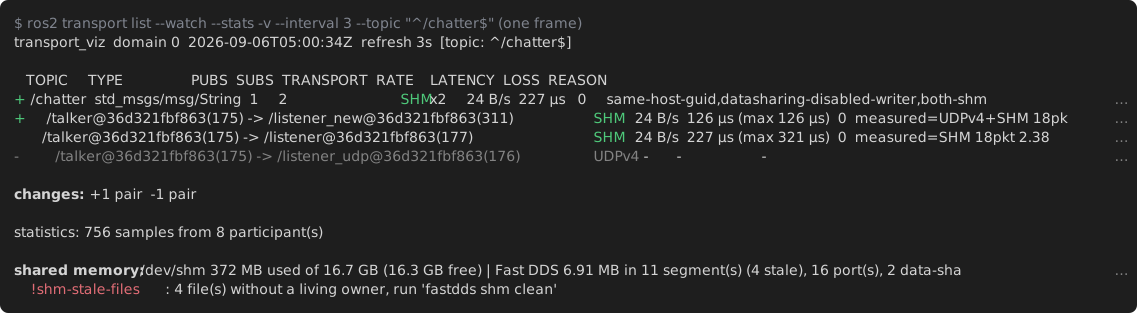
Keys while watching: q quit, p pause/resume (changes made while paused are
highlighted on resume), v toggle pair rows, e toggle the reason-code legend, a toggle
--all, l toggle --locators, f toggle --advise (the fixes). Unless both stdin and stdout are a terminal the frames are printed one after
another (without escape sequences, unless --color always); with --json every frame is one JSON Lines document that additionally
carries a changes object (added_pairs, removed_pairs, changed_pairs with
from/to).
Colors (--color auto|always|never, default auto, which honours NO_COLOR) apply to
the one-shot table as well: transports use the same palette as the web viewer and
warnings are red.
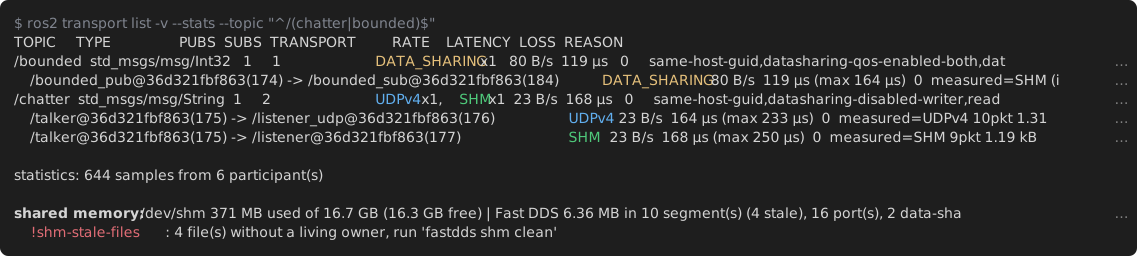
Both images are real output (scripts/render_examples.sh captures it with
--color always and scripts/ansi2svg.py turns the ANSI colors into SVG).
Comparing two snapshots
A common workflow is change a profile or an environment variable, run again, see what
moved. transport_viz diff before.json after.json (ros2 transport diff) runs the
comparison of watch mode on two saved --json documents, without a DDS participant:
ros2 transport list --json > before.json
# change the XML profile / FASTDDS_BUILTIN_TRANSPORTS / ..., restart the nodes
ros2 transport list --json > after.json
ros2 transport diff before.json after.json
The after snapshot is printed as a table with the mark column of --watch: + for a pair
that appeared, ~ for one whose transport, confidence, measured transport, selected
locator, measured locators or warnings changed, - for a pair that disappeared (a dimmed
ghost row with the labels it had before; a topic that disappeared entirely gets a ghost
topic row). The changes: summary line follows the table, and the view options of a
one-shot run apply to both documents before the comparison: --topic, --node, --all
(without it services and raw DDS topics are left out, as when observing), -v,
--explain, --locators, --advise, --color. --changes-only keeps only the topics with
a marked or removed pair.
Matching pairs. --watch matches a pair from one frame to the next by
(topic, writer GUID, reader GUID). Between two runs the nodes are usually restarted, and
every restart gives their endpoints new GUIDs, so that key would report every pair as
removed and added again. diff therefore matches by (topic, writer node, reader node)
by default (--key node): a node with several writers or readers on one topic has them
matched in GUID order, and an endpoint without a ROS node name is matched by its GUID. For
the same reason the node key ignores the port numbers of the selected and measured
locators (a restart renumbers them: 7413, 7415, ... by participant id); their kinds and
addresses still count. --key guid gives the exact --watch semantics for two frames of
the same run.
Exit status follows diff(1): 0 when nothing changed, 1 when something did, 2 on a
usage error, an unreadable file, a document of another schema_version or an invalid
one. A domain mismatch between the two documents is only a warning. One of the two
documents may be - (stdin); a JSON Lines file written by --watch --json counts by its
last document (a note on stderr says so).
JSON. With --json the output is the after document with the changes object of
--watch --json added: added_pairs, removed_pairs and changed_pairs (each pair key
carries topic, the GUIDs and writer_node / reader_node; changed_pairs[].from
also names the GUIDs the pair had in the before document), plus key (node or guid)
and before (observed_at and domain of the before document). --changes-only prunes
topics the same way as the table. The document validates against the schema, so
jq .changes extracts the bare comparison and the web viewer
highlights it (it can also compare two documents itself).